


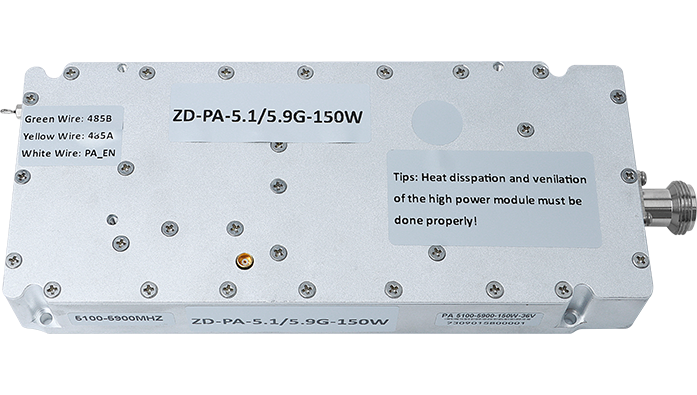

How to Choose the Right RF Power Amplifier for Your Application?
1. Start With Your Application
The first step is to understand what the RF power amplifier will be used for.
Different applications have different requirements.
For example:
| Application | Typical Amplifier Requirement |
|---|---|
| RF Testing | Stable RF output and suitable frequency range |
| Wireless Communication | Reliable output power and compact size |
| Signal Coverage | Stable continuous RF power |
| Satellite Communication | Frequency-specific high-power amplification |
| Radar | High-power RF amplification |
| RF Equipment Integration | Compact RF power amplifier module |
| OEM Equipment | Customized frequency, power and mechanical design |
Before selecting an amplifier, it is useful to tell the supplier what equipment you are developing and what the amplifier needs to do.
An experienced RF power amplifier manufacturer can then recommend a suitable solution based on the application.
2. Choose the Correct Frequency Range
Frequency is one of the first specifications you should check.
For example, your application may require:
- 400 MHz–2 GHz
- 2–6 GHz
- 5–6 GHz
- 6–7 GHz
- 6–18 GHz
- 8–12 GHz
- 18–30 GHz
- Other customized frequency ranges
The amplifier should cover the frequency range required by your RF system.
For example, if your system operates from 6 to 18 GHz, you should look for an RF power amplifier that covers the complete 6–18 GHz range.
It is also important to check whether the required output power can be maintained across the entire frequency range.
Simple example
If your system requires:
Frequency: 6–18 GHz
Output Power: 100 W
then the supplier should confirm that the amplifier is designed for 100 W operation across the required frequency range, rather than only reaching 100 W at one specific frequency.
This is one reason why working directly with an RF power amplifier manufacturer can be useful for customized applications.
3. Determine the Required Output Power
The next important question is:
How much RF output power do you need?
Common RF power levels include:
10 W / 20 W / 50 W / 100 W / 200 W / 300 W / 500 W / 1 kW
The required power depends on your application.
For example:
| Required Application | Example Power Range |
|---|---|
| Laboratory RF testing | 10–100 W |
| Small RF coverage system | 20–100 W |
| Communication equipment | 50–300 W |
| High-power RF system | 200–500 W |
| High-power transmission | 500 W–1 kW+ |
These ranges are examples only. The actual requirement should be determined by the RF system.
When choosing an RF power module, it is important to make sure the rated output power matches your actual application.
For example:
Application requirement: 80 W
Possible amplifier options might include:
- 80 W RF power amplifier
- 100 W RF power amplifier
- 150 W RF power amplifier
The appropriate choice depends on the complete system design.
4. Check the Gain
Gain describes how much the amplifier increases the RF signal.
For example, if the input RF signal is relatively weak, the amplifier needs enough gain to reach the required output power.
Typical RF power amplifier gain may vary depending on the frequency, output power and amplifier design.
When requesting an RF module, customers should provide the expected input signal level if this information is available.
For example:
Frequency: 8–12 GHz
Input Signal: 0 dBm
Required Output: 100 W
The RF power amplifier manufacturer can then determine whether the available gain is appropriate for the application.
5. Consider the Cooling Method
High-power RF amplifiers generate heat during operation.
Therefore, cooling is another important consideration.
Common cooling methods include:
Air Cooling
Air cooling is widely used for RF power amplifier modules.
Advantages include:
- Simple structure
- Easy installation
- Easy maintenance
- Suitable for many equipment designs
Heat Sink Cooling
A heat sink can be integrated directly with the RF amplifier module.
This can be useful when the customer already has a mechanical cooling structure.
Customized Cooling
For higher-power applications, customers may require a customized thermal solution.
The supplier may need information about:
- Installation space
- Ambient temperature
- Available airflow
- Heat sink size
- Equipment structure
When selecting an RF power module, do not only consider RF performance. Make sure the module can also be integrated into your equipment's cooling structure.
6. Check the Module Size
For OEM equipment manufacturers, physical dimensions can be very important.
Two RF amplifiers may have similar RF specifications but completely different mechanical designs.
Before ordering an RF module, check:
- Length
- Width
- Height
- Mounting holes
- RF connectors
- Power connectors
- Control connectors
- Cable direction
- Heat sink position
For example, an equipment manufacturer may have only a limited installation space.
In this case, a customized RF power amplifier module may be more suitable than a standard amplifier.
An experienced RF power amplifier manufacturer can often provide customized mechanical dimensions for OEM projects.
7. Check the RF Connectors and Control Interface
The RF connector is another simple but important detail.
Common RF connectors include:
- SMA
- N-Type
- TNC
- 2.92 mm
- 2.4 mm
- Other customized connectors
The connector should match the rest of the RF system.
The control interface may also need to be considered.
Depending on the application, an RF power amplifier may support:
- RS-232
- RS-485
- Ethernet
- TTL
- Analog control
- Customized control interface
For simple applications, a basic power and RF connection may be sufficient.
For integrated equipment, monitoring and control functions may be required.
8. Standard RF Amplifier or Customized RF Module?

This is a common question for equipment manufacturers.
Standard RF Power Amplifier
A standard product may be suitable when you need:
- Standard frequency
- Standard output power
- Standard dimensions
- Fast delivery
- Simple integration
Customized RF Power Module
Customization may be useful when you need:
- Special frequency
- Special output power
- Special dimensions
- Customized connectors
- Customized power supply
- Customized control interface
- Special cooling design
- OEM integration
For example, a customer may need:
6–18 GHz / 200 W / Compact Size / 28 VDC / Customized Connector
Instead of searching for an exact standard product, the customer can directly provide these requirements to an RF power amplifier manufacturer.
The manufacturer can then evaluate whether a customized RF power module or RF module can be developed.
9. Wideband or Narrowband RF Power Amplifier?
Another important consideration is the frequency coverage.
Narrowband RF Amplifier
A narrowband amplifier operates over a relatively limited frequency range.
It may be suitable when the system operates at a specific frequency band.
Wideband RF Amplifier
A wideband amplifier covers a broader frequency range.
For example:
This type of solution can be useful for:
- RF testing
- Laboratory equipment
- Communication systems
- Electronic testing
- Multi-frequency systems
If your equipment needs to operate across multiple frequencies, a wideband RF power module can potentially simplify the system design.
RF Power Amplifier Module Manufacturing and Testing
For customers purchasing RF modules for professional equipment, the manufacturer's production and testing capabilities are also important.
An experienced RF power amplifier manufacturer should be able to provide appropriate production and RF testing processes.
Testing may include:
- Output power testing
- Frequency testing
- Gain testing
- Power supply testing
- Temperature testing
- RF performance verification
- Product aging or reliability testing

How to Choose an RF Power Amplifier Manufacturer?
Selecting the amplifier is only part of the project.
For OEM and industrial applications, the supplier itself is also important.
When evaluating an RF power amplifier manufacturer, you can consider:
1. Product Range
Does the supplier cover the frequency and power range required by your project?
2. Manufacturing Capability
Can the company manufacture RF modules rather than simply distribute third-party products?
3. Testing Capability
Does the manufacturer have RF test equipment for verifying the amplifier?
4. Customization
Can the supplier modify frequency, power, dimensions, connectors or interfaces?
5. Production Capacity
Can the supplier support prototype quantities as well as volume production?
6. Technical Communication
Can the engineering team understand your RF requirements and provide appropriate technical feedback?
These factors are particularly important when the amplifier will become part of a customer's own equipment.
Why Choose ZD TECH for RF Power Amplifier Modules?
ZD TECH develops and manufactures RF power modules, RF modules and RF power amplifier solutions for communication, RF testing, signal coverage and other RF applications.
Our product range includes different frequency and power configurations, allowing customers to select solutions according to their application requirements.
For OEM projects, ZD TECH can discuss requirements such as:
- Frequency range
- Output power
- Module dimensions
- RF connectors
- Power supply
- Cooling
- Control interface
- Production quantity
As an RF power amplifier manufacturer, ZD TECH focuses on providing practical RF amplification solutions for equipment manufacturers, system integrators and engineering teams.
Whether you need a standard RF module or a customized RF power module, providing your basic RF requirements allows our engineers to evaluate the appropriate solution.
Conclusion
Choosing an RF power amplifier does not need to be complicated.
For most applications, start with the following basic requirements:
Application + Frequency + Output Power + Gain + Cooling + Size + Interface
Once these requirements are defined, an experienced RF power amplifier manufacturer can help you identify the appropriate solution.
For OEM projects, a customized RF power module or RF module may also be developed according to the customer's system requirements.
ZD TECH provides RF power amplifier modules and customized RF solutions for communication, testing, signal coverage and other RF applications.
Looking for an RF Power Amplifier Module?
Send us your basic requirements:
Frequency | Output Power | Application | Cooling | Size | Quantity
Our engineering team can evaluate the appropriate RF power module solution for your project.